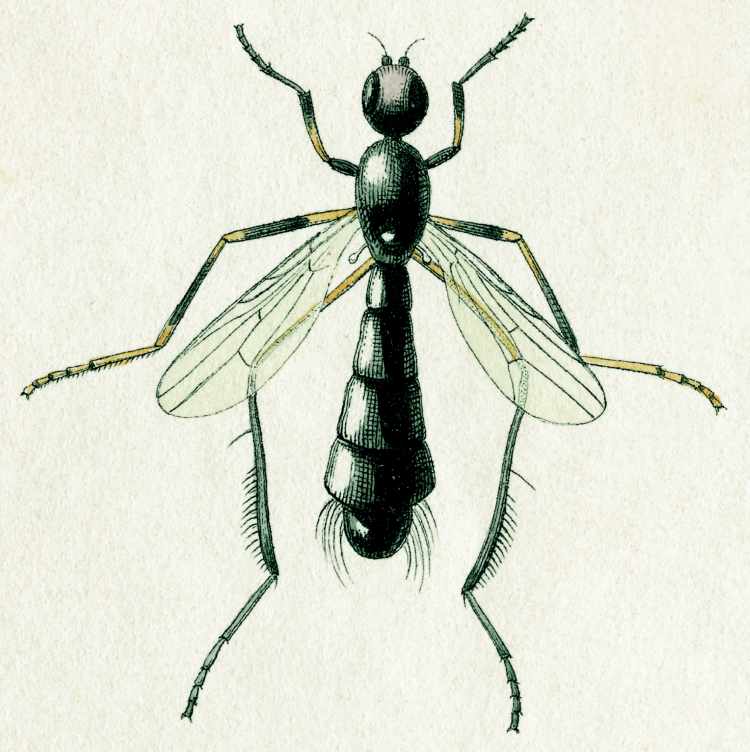
Diagnosis. Small, generally black flies (2.5-6.5 mm). Head small, eyes very small to large, dichoptic in both sexes; antennae relatively short, arista bare; orbital and outer vertical setae present or absent. Thorax without strong acrostichal setae; pleura often with distinct pattern of silver pruinosity; posterior spiracle with a strong seta near posteroventral corner. Wings without costal breaks; anal vein not reaching wing margin; wing tips with black marking (Sepsis) or clouding (Nemopoda). Legs slender; male fore legs (except in Orygma) often with extensive modification to facilitate holding the female during copulation; male hind tibia often with osmeterium consisting of glandular hairs.
Biology. Larvae of Sepsidae are generally coprophagous (Meroplius, Saltella, Sepsis, some Themira) or living of decomposing organic matter (Nemopoda from rotting snails and fungi, Orygma on decaying see weed, some Themira from birds' nests, rich organic mud and sewage waste). Adults are mainly found in open to semi-enclosed habitats, like meadows, nears streams and ponds, along wood edges and at clearings; Orygma is only found at beaches. Sepsis fulgens (sometimes with occasional specimens of other Sepsis species) can form extremely large aggregations of many thousands of specimens on low vegetation or shrubs. These aggregations can persist for more than a month and may be accompanied by a distinct smell.
General references. Van der Goot (1985a, 1985b [faunistics], 1986a [faunistics], 1986b [biology Sepsis fulgens]), Gregor (1966 [Themira]), Meier & Pont (2000 [general, key to genera]), Pont (1979 [general, biology, keys], 1986c [diagnostics], 1987 [biology Sepsis fulgens]), Steyskal (1987g [general, key to genera]), Zuska (1965 [Nemopoda]), Zuska & Pont (1984 [catalogue]).
References to the local fauna. Van Aartsen (1997), Van der Goot (1985a, 1985b, 1986a, 1987, 1989a), De Meijere (1939b), Van der Wulp (1864b, 1871), Van der Wulp & De Meijere (1898), Zuska & Pont (1984).
How to quote this page: Beuk, P.L.Th., 2021. Family Sepsidae. In: Beuk, P.L.Th. (Ed.): Checklist of the Diptera of the Netherlands, https://diptera-info.nl/news.php?fam=Sepsidae (date accessed: 05/06/2026).
Sepsis nigripes was earlier recorded from the Netherlands but it formally deleted by Van der Goot (1985b: 178) because records were based on misidentifications. Zuska & Pont (1984: 167) listed it as nomen dubium but Pont (1986c) later redescribed it and re-instated it as valid species. Recent Dutch material confirmed this species as Dutch.
Note 2
Formally added by Van der Goot (1985b: 178).
Note 3
Zuska & Pont (1984: 165) erroneously treated T. dentimana as synonym of T. minor. Possibly this is due to the fact that Van der Wulp & De Meijere (1898: 115) and De Meijere (1939b: 159) placed it in synonymy with T. consobrina (= minor). There always has been a lot of confusion about T. minor and T. lucida. However, Van der Wulp (1864b: pl. 8, fig. 6) clearly figures a fore leg of a species in which the second tarsal segment is longer than the third (character for T. lucida).
Note 4
Themira consobrina was described by Van der Wulp for T. minor Haliday sensu Schiner and Van der Wulp. The type specimens are the material mentioned under T. minor in Van der Wulp (1864b: 134), to which he refers. All or most material is still present at ZMAN and belongs to T. minor.
The latest revisions at different levels
The family introduction was last edited on 03-09-2021 18:19
Themira gracilis was the last (sub)species to be edited on 29-12-2017 18:03

 31,110,000 unique visits