31,114,585 unique visits
Navigation
General chapters
Introduction
The 2002 Checklist (introduction)
History of Dutch lists
Applications of the list
Contributors
Bibliography
Contribute
Message to Webmaster
Submit Reference
Select family
Users Online
Guests Online: 2

Members Online: 0

Total Members: 5
Newest Member: Kees Boele
Login
Username

Password


Not a member yet?
Click here to register.

Forgotten your password?
Request a new one here.
Forum Threads
Newest Threads
No Threads created
Hottest Threads
No Threads created
FAMILY TABANIDAE
Theo Zeegers, Ton van Haaren and Paul L.Th. Beuk Version date: 02-02-2022 14:44

Tabanidae
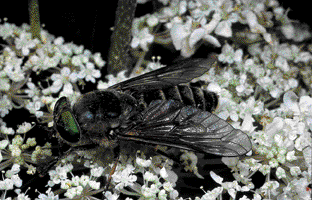
Diagnosis. Medium-sized to very large (6.0-27.0 mm) flies with large eyes. Antennae with six or more segments, usually only basal three segments well developed. Each tarsus with enlarged empodium, therefore apparently three pulvilli present. Scutellum without spines or bristles. Wing venation extended, vein R4+5 split near top of wing. Eyes in living flies brilliantly reddish or metallic green, sometimes yellowish, often with spots or bands; in males holoptic, in females narrowly separated. Upper facets of eye in males often significantly enlarged. Eggs elongate oval or spindle-shaped. Originally milk-white to pale yellowish, becoming soon after oviposition darker, finally very dark grey to almost black; chorion often with surface pattern. Larvae cylindrical or spindle-shaped, tapering at both ends. Last abdominal segment with a terminal vertical fissure and Graber's organ (probably used for sensory perception). Body usually longitudinally striated. Head capsule not strongly sclerotized, and retractile. Pupa obtect, with distinct visible head, thorax and abdomen, with characteristic anal aster and species-specific spines in combs on abdominal segments. Head often has distinct antennal ridge, or paired tubercles between antennal sheaths.

Biology. Females are notorious for bloodsucking on mammals, including man. Feeding on blood is used to develop the eggs but apparently not necessary for the first batch. Females lay eggs usually on leaves of herbs and trees and dry twigs close to or just above water. The eggs are laid in masses of up to 1000 eggs consisting of one (Chrysops) to four layers. Some species can be found on flowers. Males of several species hover territorially (like Syrphidae), of other species males seem quite inactive. Larvae from one egg-mass hatch almost at the same time, one to three weeks after oviposition, and fall onto damp soil or directly onto water. The larvae grow through 6-11 instars and will pupate under dryer conditions in late spring. After one to four weeks the adult emerges usually early in the morning.

General references. Chvála (1988a [catalogue]), Chvála & Ježek (1997 [immature stages]), Chvála et al. (1972 [keys]), Pechuman & Teskey (1981 [general]), Smith (1989 [immature stages]), Zeegers & Van Haaren (2000 [keys to adults & larvae])

References to the local fauna. .Van Aartsen (1992c, 1997), Kabos (1960), Leclercq (1967), Mol (1984), Piet (1946a), Theowald (1953), Timmer (1974, 1979, 1980), Zeegers (2002), Zeegers & Van Haaren (2000).
 
Remarks. The number of species in Belgium taken from Zeegers & Van Haaren (2000). Original data by Zeegers & Van Haren, corrections and updates (publication years marked in red) by Beuk.

How to quote this page: Zeegers, Th., T. van Haaren, & P.L.Th. Beuk, 2022. Family Tabanidae. In: Beuk, P.L.Th. (Ed.): Checklist of the Diptera of the Netherlands, https://diptera-info.nl/news.php?fam=Tabanidae (date accessed: 09/06/2026).

NL: 37 B: 41 D: 38 UK: 30 World: ± 3500
 
TABANIDAE
 
CHRYSOPSINAE
 
  Chrysopsini
                 
  Chrysops Linnaeus, 1758
  subg. Chrysops Linnaeus, 1758
  caecutiens (Linnaeus, 1758)
  = coecutiens (Linnaeus, 1758): incorrect spelling
  relictus Meigen, 1820
  rufipes Meigen, 1820
  sepulcralis (Fabricius, 1794)
  = sepulchralis (Fabricius, 1794): incorrect spelling
  = maurus Siebke, 1864
  viduatus (Fabricius, 1794)
  = pictus Meigen, 1820
  = quadratus Meigen, 1820
 
TABANINAE
 
  Diachlorini
                 
  Philipomyia Olsufjev, 1964
  aprica (Meigen, 1820) N; added by Van Aartsen (1997: 7
 
  Haematopotini
                 
  Haematopota Meigen, 1803
  = Chrysozona Meigen, 1800: suppr.
  bigoti Gobert, 1880 N; added by Timmer (1974: 131
  crassicornis Wahlberg, 1848 N; added by Chvála et al. (1972: 28
  italica Meigen, 1804 N; added by Chvála et al. (1972: 28
  pluvialis (Linnaeus, 1758) N; added by Chvála et al. (1972: 28
  subcylindrica Pandellé, 1883 N; added by Chvála et al. (1972: 28
                 
  Heptatoma Meigen, 1803
  pellucens (Fabricius, 1776)
  = bimaculata Meigen, 1804
 
  Tabanini
                 
  Atylotus Osten Sacken, 1876
  = Ochrops Szilády, 1915
  fulvus (Meigen, 1804)
  latistriatus Brauer in Brauer & von Bergenstamm, 1880
  plebeius (Fallén, 1817)
  = plebejus (Fallén, 1817): incorrect spelling
  = sublunaticornis (Zetterstedt, 1842): misident.
  rusticus (Linnaeus, 1767)
                 
  Hybomitra Enderlein, 1922
  = Therioplectes Zeller, 1842: misident. sensu auct.
  arpadi (Szilády, 1923) N; added by Zeegers (2002a: 81
  bimaculata (Macquart, 1826)
  = tropica (Linnaeus, 1758): misident. sensu auct.
  = solstitialis (Meigen, 1820): misident. sensu Lyneborg, 1959 Note 1
  = bisignata (Jaennicke, 1866)
  ciureai (Séguy, 1937)
  = solstitialis (Meigen, 1820) Note 2
  = schineri Lyneborg, 1959
  distinguenda (Verrall, 1909) N; added by Kabos (1960: 11
  expollicata (Pandellé, 1883) N; added by Leclercq (1967: 11
  lundbecki Lyneborg, 1959 N; added by Leclercq (1967: 11
  lurida (Fallén, 1817)
  micans (Meigen, 1804)
  montana (Meigen, 1820)
  = borealis (Fabricius, 1781): misident. sensu auct.
  = flaviceps (Zetterstedt, 1842)
  = nigricornis (Zetterstedt, 1842): misident.
  = tuxeni Lyneborg, 1959: misident.
  muehlfeldi (Brauer in Brauer & von Bergenstamm, 1880) N; added by Leclercq (1967: 11
  tropica (Linnaeus, 1758) N; added by Zeegers & Van Haaren (2000: 18, 57
  = tuxeni Lyneborg, 1959
                 
  Tabanus Linnaeus, 1758
  = Eutabanus Kabos, 1960
  autumnalis Linnaeus, 1761
  bovinus Linnaeus, 1758
  bromius Linnaeus, 1758
  cordiger Meigen, 1820
  maculicornis Zetterstedt, 1842
  miki Brauer in Brauer & von Bergenstamm, 1880 N; added by Zeegers & Van Haaren (2000: 18, 69, 105
  quatornotatus Meigen, 1820 N; added by Van Aartsen (1992c: 15
  rectus Loew, 1858 N; added by Timmer (1979: 148
  sudeticus Zeller, 1842
                 
  Therioplectes Zeller, 1842
  gigas Herbst, 1787
 
Notes
Note 1 Misidentification pointed out by Zeegers (2018: 89).
Note 2 Synonymy established by Zeegers (2018: 89).
 
The latest revisions at different levels
The family introduction was last edited on 02-02-2022 14:44
Hybomitra solstitialis was the last (sub)species to be edited on 17-08-2018 09:51


Copyright Paul Beuk 2002-2020
White_n_Light Theme by: Smokeman
Powered by PHP-Fusion copyright © 2002 - 2026 by Nick Jones.
Released as free software without warranties under GNU Affero GPL v3.
Render time: 0.86 seconds