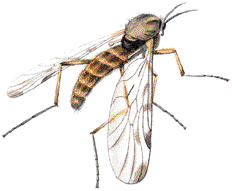
Diagnosis. Small to medium-sized (6.0-12.0 mm) nematocerous flies with longish, slender legs. Body yellowish to brownish and with many small setae. Head small and rounded; mouthparts small; antennae considerably longer than head, 16-segmented. Wings rather large, membrane at least with markings along anterior margin but sometimes with extensive markings across most of the surface; discal cell present and emitting three veins; second anal vein not very distinct inSylvicola . Abdomen elongate. Larvae long and narrow, pale; head strongly sclerotized dorsally. Pupal abdomen with many spines.
Biology. Adults are frequently found on vertical surfaces (tree trunks, walls, windows). Males form swarms to attract females for mating. Larvae are saprophagous and can be found in a wide range of rotting or fermenting organic matter, e.g., manure, wood, sap runs.
References to the local fauna. Van Aartsen et al. (1991), Beuk (1997), Lempke (1962).
How to quote this page: Beuk, P.L.Th., 2001. Family Anisopodidae. In: Beuk, P.L.Th. (Ed.): Checklist of the Diptera of the Netherlands, https://diptera-info.nl/news.php?fam=Anisopodidae (date accessed: 13/06/2026).
NL: 6
B: 5
D: 6
UK: 4
World: 120
ANISOPODIDAE
Sylvicola Harris, 1776
subg. Anisopus Meigen, 1803
fuscatus (Fabricius, 1775)
N
Note 1
punctatus (Fabricius, 1787)
N
stackelbergi Krivosheina & Menzel, 1998
N; will be formally added by Beuk (in prep.)
subg. Sylvicola Harris, 1776
cinctus (Fabricius, 1787)
N; will be formally added by Beuk (in prep.)
fenestralis (Scopoli, 1763)
N
zetterstedti (Edwards, 1923)
N; will be formally added by Beuk (in prep.)
Notes
Note 1
All previously recorded Dutch material should be checked to see whether the material involved belongs to S. fuscatus (= subfuscatus Krivosheina & Menzel, 1998), S. stackelbergi or maybe S. fuscatoides Michelsen, 1999 (= fuscatus sensu Krivosheina & Menzel, 1998). Confirmed material was, for example, recorded on Diptera.info.

 31,119,697 unique visits