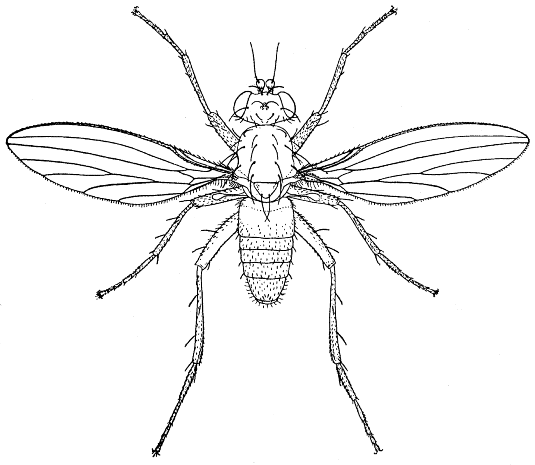
Diagnosis. Rather small (2.0-5.0 mm), strongly bristled flies, yellow to brownish black, often yellowish brown with darker pattern. Head with broadly separated eyes; two pairs of fronto-orbital setae; one pair of ocellar setae; two pairs of vertical setae. Wings lanceolate, venation sexually dimorphic; C without breaks; cross-veins only near the base of the wing.
Biology. Adults are common in wet places, along streams or ponds, in deciduous forests, or even in dry meadows. They may be found all year round and at least some species have more than one generation a year. Most species are bisexual, but at leastL. bifurcata is parthenogenetic in most areas of its nearly cosmopolitan range. Larvae are saprophagous, microphagous or, presumably, mycetophagous. They may be found among dead leaves, in plant debris and other decaying material in gardens, forests and meadows.
General references. Andersson (1991 [catalogue]), Barták (1986 [key], 1998 [general]), De Meijere (1906 [Palaearctic species, key]), Peterson (1987a [general]).
References to the local fauna. De Meijere (1906), Van Zuijlen (1996d).
How to quote this page: Zuijlen, J.W.A. van, 2014. Family Lonchopteridae. In: Beuk, P.L.Th. (Ed.): Checklist of the Diptera of the Netherlands, https://diptera-info.nl/news.php?fam=Lonchopteridae (date accessed: 08/06/2026).
NL: 7
B: 6
D: 7
UK: 7
World: 45
LONCHOPTERIDAE
Lonchoptera Meigen, 1803
= Musidora Meigen, 1800:
bifurcata (Fallén, 1810)
N
= furcata (Fallén, 1823)
fallax De Meijere, 1906
T
lutea Panzer, 1809
N
meijerei Collin, 1938
N
nitidifrons Strobl, 1899
N; added by Van Zuijlen (1996d: 59)
scutellata Stein, 1890
N; added by Van Zuijlen (1996d: 59)
tristis Meigen, 1824
N
The latest revisions at different levels
The family introduction was last edited on 12-03-2014 09:44

 31,112,873 unique visits